
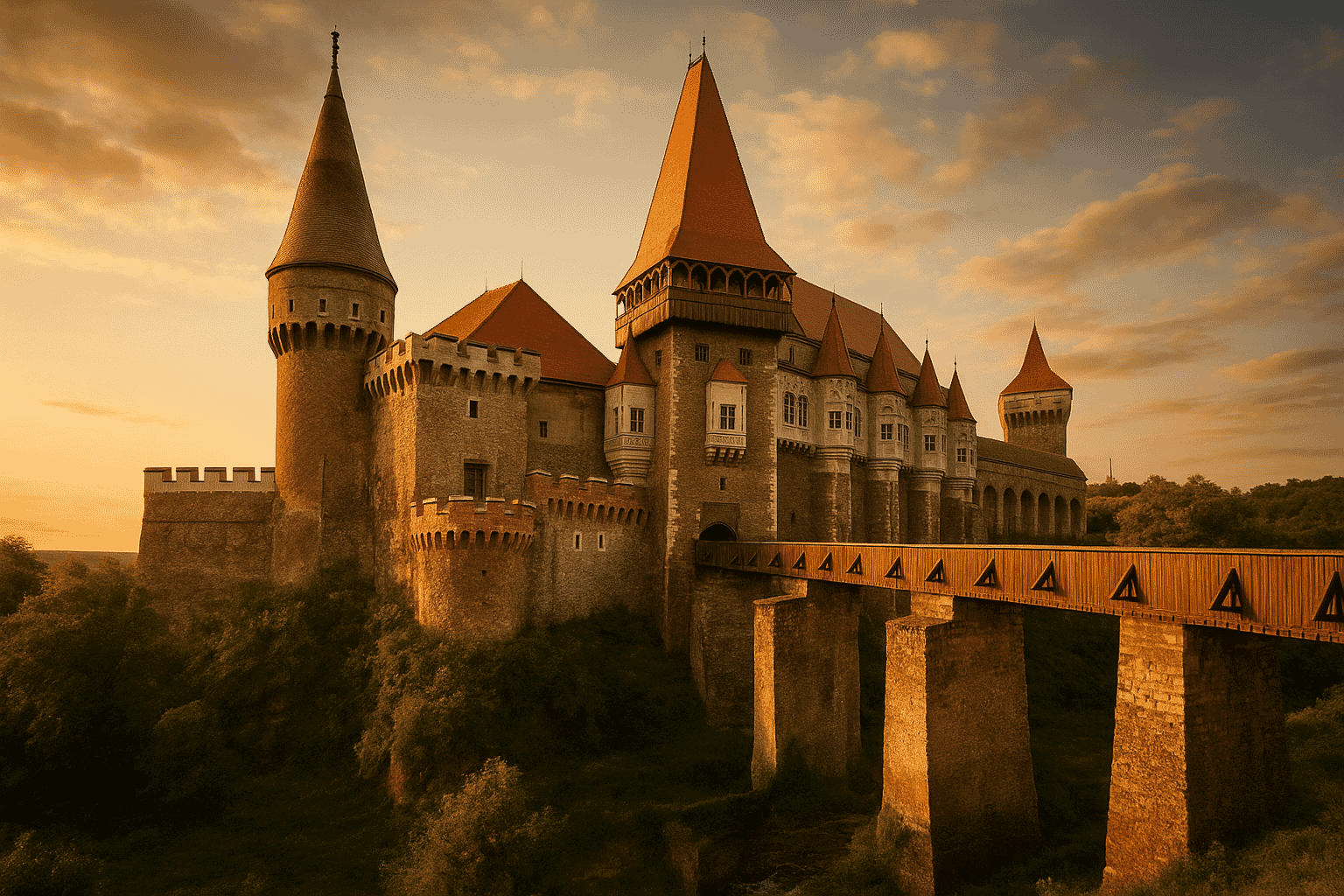
Castelul Corvinilor: The Legendary Fortress of Transylvania Where Myth Meets History
Perched on a rocky cliff in the small city of Hunedoara, Castelul Corvinilor (Corvin Castle) stands as one of the most impressive medieval fortresses in Europe. Its towering spires, drawbridge, and legends of Dracula draw visitors from around the world. But beyond the myths lies a rich history of Hungarian kings, Ottoman battles, and Renaissance artistry. This article separates fact from fiction, revealing the true story of Castelul Corvinilor while exploring the enduring tales that make it a must-see destination in Transylvania.
Castelul Corvinilor: Construction and History
Corvin Castle's origins date back to the 14th century, when it was built on the site of a Roman fort. The fortress gained its prominence under John Hunyadi (Iancu de Hunedoara), the Regent of Hungary and a legendary military leader. In 1446, Hunyadi began a massive expansion, transforming the castle into a Gothic masterpiece with defensive walls, towers, and a chapel. After his death, his son, King Matthias Corvinus, added Renaissance elements, such as the Loggia and the Knights' Hall. The castle remained a royal residence until the 17th century, then fell into disrepair. A major restoration in the 19th century under the Habsburgs added Neo-Gothic features, including the iconic towers and the wooden drawbridge we see today. The castle covers 7,000 square meters and features 50 rooms, two large halls, and a deep well. Its strategic location on the Zlaști River helped control trade routes and defend against Ottoman incursions.
The Legend of the Raven and the Ring at Castelul Corvinilor
One of the most beloved legends explains the castle's name. According to the story, John Hunyadi's father, Voicu, was a nobleman of Romanian origin. One day, while riding near the river, he inadvertently dropped his gold signet ring into a well. Heartbroken, he prayed for a miracle. Suddenly, a raven ("corb" in Romanian) swooped down, retrieved the ring, and placed it on a nearby stone. Voicu took this as a sign that the family's fortune would rise. He adopted the raven as his crest, and later, his son Matthias chose the raven for the Hunyadi family coat of arms. Thus, the castle became known as "Castelul Corvinilor" – the Castle of the Raven. This legend is depicted in the castle's art, including a raven with a ring in its beak. Historians note that the Corvinus name itself derives from the Latin word for raven (“corvus”), adding a layer of linguistic truth to the tale.
The Imprisonment of Vlad Țepeș at Castelul Corvinilor: Fact or Fiction?
Perhaps the most sensational story is that Vlad the Impaler (the real Dracula) was held captive at Castelul Corvinilor for seven years. According to the legend, Vlad was captured by the Hungarians in 1462 after his defeat by the Ottomans and was imprisoned in a tower room. During his captivity, he allegedly refined his cruel methods, later applying them in Wallachia. However, historical records cast doubt on this claim. Most historians believe Vlad was actually held in a fortress in Visegrád, Hungary. Castelul Corvinilor's association with Dracula grew popular in the 19th century, fueled by Bram Stoker's novel and tourism. Yet, there is a grain of truth: Vlad did meet with John Hunyadi in 1448, and the castle likely housed prisoners from Wallachia. Whether Vlad actually stayed there remains unproven, but the legend persists, making the castle a pilgrimage site for Dracula enthusiasts. The alleged prison tower is now a popular attraction, complete with a plaque describing his confinement. If you are fascinated by Dracula lore, consider visiting Castelul Bran (Dracula's Castle) to compare the legends.
The Well Legend: Turkish Prisoners and Hidden Treasure
Another haunting tale originates from the castle's deep well, which plunges nearly 150 feet (45 meters) into the bedrock. The legend says that during a siege, the castle's water supply was cut off. The defenders, desperate for water, captured three Turkish prisoners and forced them to dig a new well inside the courtyard. The prisoners were promised freedom once they reached water. After years of labor, they struck water, but instead of releasing them, the castle guards executed them. Before dying, the prisoners supposedly cursed the castle, saying that the water would never be drinkable. Indeed, the well water contains high levels of minerals, making it bitter and undrinkable. Some legends add a twist: the Turks buried a treasure at the well's bottom. No treasure has ever been found, but the story adds to the castle's eerie atmosphere. The well is now a highlight of the tour, often pointed out by guides.
Ghost Stories and the Lady of the Castle
Castelul Corvinilor is reputed to be one of the most haunted places in Romania. Visitors and staff report mysterious footsteps, cold drafts, and apparitions. The most famous ghost is the "Lady of the Castle" – the spirit of a noblewoman who died tragically. According to one tale, she was the wife of a Hungarian lord who imprisoned her in a tower after she fell in love with a Turkish captive. She wasted away and now wanders the battlements. Another story tells of a man whose wife punished him by locking him in the bear pit (where executions took place); his ghost is said to stalk the courtyard. Paranormal investigators have conducted séances, claiming to capture EVPs. Whether you believe in ghosts or not, the castle's dimly lit corridors and medieval ambiance make for an unforgettable, spine-tingling visit. Evening tours are particularly popular for those seeking a supernatural experience.
Architectural Highlights and Restoration
Castelul Corvinilor is a stunning blend of Gothic and Renaissance styles, with later Neo-Gothic additions. Key features include:
- The Knights' Hall: A vast room with ribbed vaults, marble columns, and a monumental fireplace, used for banquets and councils.
- The Diet Hall: Where the Transylvanian Diet once met; it features a beautiful Renaissance loggia.
- The Capistrano Tower: Named after St. John of Capistrano, it offers panoramic views.
- The Bear Pit: A circular enclosure where bears were kept for entertainment and executions.
- The Chapel: A small Gothic chapel with frescoes.
- The Drawbridge: An impressive wooden bridge over a moat, reconstructed in the 19th century.
During the 2013–2015 restoration, the castle was closed to the public. Renovations repaired structural damage, restored frescoes, and added modern lighting. Today, the castle is immaculate, but some critics argue the restoration made it look too “new.” Nonetheless, it remains a prime example of medieval military architecture and is often used as a filming location for historical movies.
Frequently Asked Questions about Castelul Corvinilor
How did Castelul Corvinilor get its name?
The name comes from the Hungarian "Corvinus," meaning "raven." Legend says a raven retrieved a lost ring for John Hunyadi's father, leading the family to adopt the raven as their crest. The Romanian name "Castelul Corvinilor" translates to "Castle of the Ravens."
Was Vlad the Impaler really imprisoned here?
Historical evidence is inconclusive. While tradition claims Vlad was held for seven years, most scholars believe he was imprisoned in Hungary. The story likely emerged from 19th-century romantic literature. Nevertheless, the legend fuels the castle's Dracula connection.
What is the legend of the well inside the castle?
According to folklore, three Turkish prisoners were forced to dig the well under promise of freedom. After they hit water, they were executed. They cursed the water, making it undrinkable. Some versions claim a treasure is hidden at the bottom.
Who built Castelul Corvinilor and when?
Construction began in the 14th century, but the castle was largely expanded by John Hunyadi in the 1440s. Later, his son King Matthias Corvinus added Renaissance touches. The castle underwent major Neo-Gothic restoration in the 19th century.
Is Castelul Corvinilor haunted?
Many visitors report paranormal activity, including ghostly apparitions and unexplained sounds. The most famous ghost is the "Lady of the Castle." While skeptics dismiss such claims, the castle's atmosphere certainly contributes to its haunted reputation.
What architectural styles are present in the castle?
The castle primarily features Gothic architecture with Renaissance additions. The 19th-century restoration introduced Neo-Gothic elements, such as the spires and the drawbridge. This blend makes it a unique architectural landmark.
Explore More Romanian Castles
If you loved Castelul Corvinilor, check out our guide to the top 10 castles in Romania for more medieval wonders. You can also plan a Transylvania castle tour to visit multiple fortresses in one trip.